
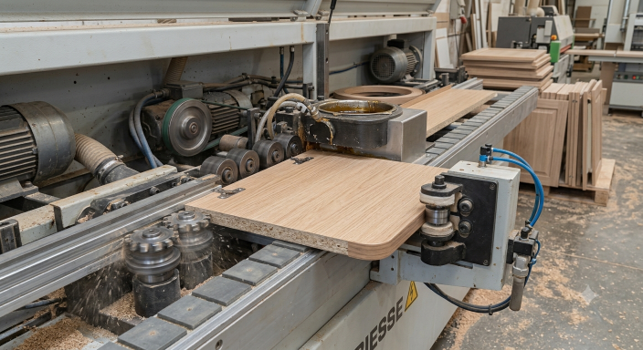
A batch of kitchen cabinet panels came back for rework last monsoon season, with sharp edges where rounded corners were specified, and a banding line that looked slightly wavy under proper lighting. Both problems traced back to the same missing feature. An Edge Banding Machine with Premilling would have caught the edge irregularity before banding even began, and a corner rounding unit would have handled the profile automatically. Understanding what these two functions actually do helps manufacturers avoid exactly this kind of costly mistake.
What Premilling Actually Does
Premilling happens before the banding process begins, and its job is deceptively simple: clean up the panel edge so it’s perfectly straight and free of chips or rough spots left over from the initial panel cutting stage.
What premilling addresses specifically:
- Removes small chips or splinters along the raw panel edge
- Creates a perfectly straight surface for banding material to adhere to
- Corrects minor inconsistencies from the panel cutting process
- Improves overall bond strength by giving glue a cleaner surface to grip
Without this step, banding material gets applied directly onto whatever irregularities exist on the raw edge, and those imperfections often show through even after the banding process completes.
Why Panel Cutting Alone Isn’t Enough
Most panel cutting equipment, even good quality saws, leave microscopic chipping or slight unevenness along cut edges. This isn’t really a flaw in the cutting process itself; it’s simply an inherent limitation of cutting composite materials like MDF or particleboard. Premilling exists specifically to correct this before it becomes a visible problem later.
How Premilling Improves Final Bond Quality
The connection between premilling and strong adhesion isn’t obvious at first glance, but it matters considerably once you understand the mechanics involved.
Ways premilling directly affects bonding outcomes:
- Cleaner surface contact, allowing glue to distribute evenly without gaps
- Consistent edge geometry, ensuring banding material presses uniformly along the entire length
- Reduced trapped air pockets, which otherwise cause bubbling under the banding
- Fewer visible defects, particularly noticeable on lighter coloured or glossy finishes
A machine lacking this premilling function relies entirely on the panel’s original cut quality, which varies depending on blade sharpness, cutting speed, and material consistency, factors largely outside the edge banding process itself.
Materials That Benefit Most From Premilling
Particleboard and lower-density MDF, both common in budget and mid-range furniture manufacturing, tend to chip more easily during cutting compared to denser materials. For manufacturers working primarily with these materials, premilling isn’t really optional; it becomes essential for consistent, professional-looking output.
Understanding Corner Rounding Function
Corner rounding solves an entirely different problem, though it often gets grouped together with premilling since both relate to edge preparation quality.
What corner rounding accomplishes:
- Shapes sharp panel corners into smooth, rounded profiles automatically
- Eliminates manual sanding or shaping that would otherwise be required
- Ensures consistent radius across every single panel processed
- Reduces injury risk from sharp corners in finished furniture pieces
Furniture designed with rounded edges, common in children’s furniture, hospitality settings, and modern residential designs, genuinely requires this function built into the production line rather than relying on manual finishing afterwards.
Why Consistency Matters More Than Manufacturers Initially Assume
A slightly different corner radius between panels might seem like a minor detail, but when furniture pieces sit side by side – cabinet doors, drawer fronts, tabletop edges – any inconsistency becomes immediately visible to a careful observer. Automated corner rounding removes this variability entirely from the equation.
Choosing Machines With These Features
Not every edge banding machine on the market includes both premilling and corner rounding as standard features, and understanding when they’re genuinely necessary helps avoid overpaying for capability your production doesn’t actually need.
Questions worth asking before prioritising these features:
- Does your material typically show chipping or edge irregularity after cutting?
- Do your furniture designs regularly require rounded rather than square corners?
- Is your current rework rate related to edge quality issues specifically?
- Would eliminating manual finishing steps genuinely save meaningful production time?
For manufacturers working with denser, higher-quality boards and producing exclusively straight edge furniture, these features matter considerably less. For those working with variable quality material or design heavy furniture lines, they become genuinely important.
Balancing Added Cost Against Genuine Benefit
Machines including both premilling and corner rounding naturally cost more than simpler alternatives. That additional cost makes sense specifically when it eliminates rework, reduces manual labour, or improves output consistency enough to justify the investment over time.
Maintenance Considerations for These Functions
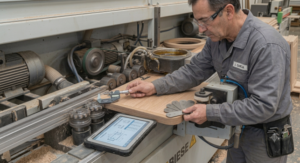
Both premilling and corner rounding units require their own specific maintenance attention, separate from the main glueing and trimming components of the machine.
Maintenance practices worth building into routine schedules:
- Regular blade sharpness checks on premilling cutters
- Periodic calibration of corner rounding radius settings
- Cleaning of dust and debris that accumulates around cutting heads
- Prompt replacement of worn cutting tools rather than pushing them past their useful life
Neglecting these specific components, while focusing maintenance attention solely on the glue and trimming system, gradually degrades the exact quality improvements these features were meant to provide.
Making the Right Choice for Your Production Line
Deciding whether these features genuinely suit your operation comes down to honestly assessing current material quality, design requirements, and existing rework patterns rather than simply following what competitors have installed.
Conclusion
Premilling and corner rounding solve genuinely distinct problems in the edge banding process, one improving bond quality through better edge preparation, the other automating a shaping task that would otherwise require manual finishing. Understanding which features your specific production line actually needs prevents both overspending and quality shortfalls. At Garnet India, we help manufacturers choose edge banding machinery configured precisely for their material and design requirements, rather than a generic one-size-fits-all setup.
Frequently Asked Questions
Is premilling necessary if my panels are already cut cleanly?
It depends on material consistency; denser boards with clean cuts may need it less, though most composite materials still benefit from the additional edge preparation.
Can corner rounding be added to a machine that doesn’t currently have it?
This varies by manufacturer and model; some machines allow modular additions, while others require purchasing a unit with the function built in from the start.
Does premilling significantly slow down production speed?
It adds a small amount of processing time per panel, though this is generally offset by reduced rework and improved bond quality across the finished output.
What furniture types most commonly require corner rounding functionality?
Children’s furniture, hospitality furnishings, and modern residential designs frequently specify rounded corners, making this feature particularly valuable for manufacturers serving those seg