
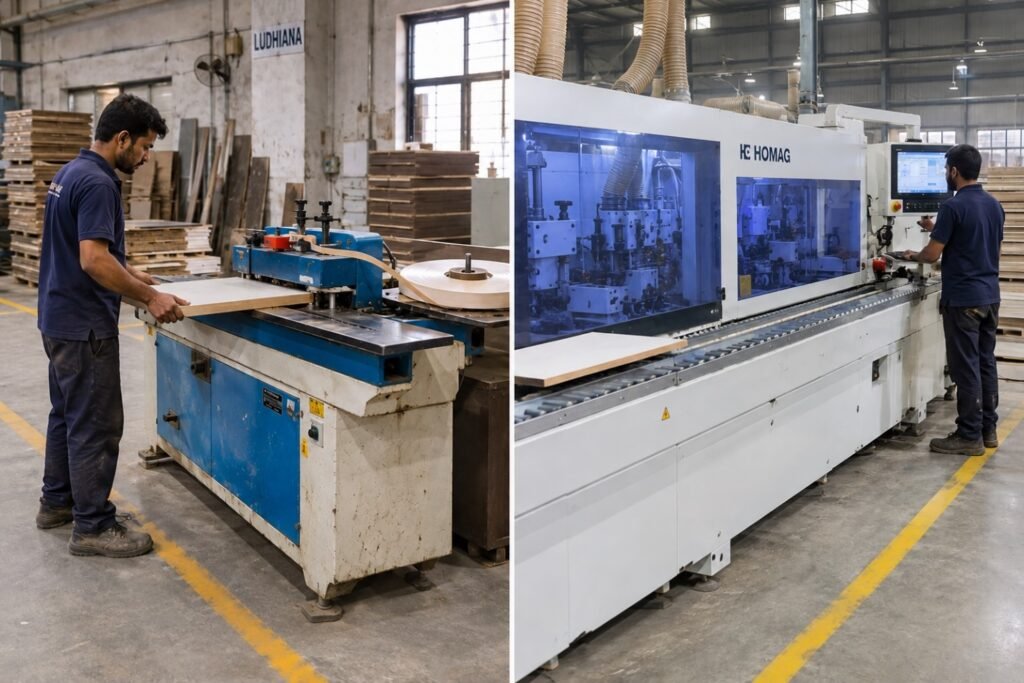
A factory supervisor in Ludhiana once ran both setups side by side for a month, just to settle an argument between two shift managers. The comparison of Manual vs Automatic Edge Banding Machine setups isn’t just a theoretical debate; it directly affects output, labour cost, and how consistent your furniture actually looks once it leaves the workshop. Choosing between the two comes down to understanding what each option genuinely offers your specific business.
Understanding the Basic Difference
Before comparing costs or output, it helps to understand what separates these two approaches at a fundamental level.
A manual edge banding process relies on a worker applying banding tape by hand, often using a simple iron or basic trimming tool. An automatic setup handles the entire process – feeding, gluing, trimming, and finishing – through a single machine with minimal operator intervention.
Core differences worth understanding upfront:
- Manual processes depend heavily on individual worker skill and consistency.
- Automatic machines maintain uniform quality regardless of who operates them.
- Labour requirements differ significantly between the two approaches.
- Initial investment costs vary considerably, with manual requiring far less upfront capital.
Neither approach is universally correct. The right choice depends entirely on your production volume, budget, and long-term business goals.
Why This Decision Matters More Than It Seems
Many workshop owners treat this choice as purely financial, simply comparing purchase price against labour cost. That view misses a lot. Consistency, delivery timelines, and even customer perception of quality all tie back to which method you’re using daily.
The Case for Manual Edge Banding
Manual methods still make sense for certain businesses, and dismissing them entirely would be misleading.
Situations where manual banding genuinely works well:
- Very low production volume, a handful of panels weekly rather than daily
- Highly customized or irregularly shaped furniture pieces requiring individual attention
- Limited capital available for larger equipment investment
- Workshops just starting out, testing demand before committing to automation.
Advantages manual methods offer:
- Significantly lower upfront investment compared to automated machinery.
- Flexibility for unusual shapes or one-off custom pieces
- No dependency on electrical supply or machine maintenance schedules
- Simpler troubleshooting when something goes wrong mid-process
Where Manual Methods Genuinely Fall Short
Consistency becomes the obvious weak point once volume increases even slightly. Two different workers applying banding by hand rarely produce identical results, and that variation becomes a real problem when clients expect uniform quality across a bulk order.
The Case for Automatic Edge Banding
For businesses processing meaningful volume regularly, automation solves problems that manual methods simply cannot address at scale.
Where automatic machines clearly outperform manual methods:
- Consistent finish quality across hundreds or thousands of panels
- Significantly faster processing time per panel
- Reduced dependency on highly skilled manual labour
- Lower material wastage through precise, repeatable trimming
A Manual Edge Banding Machine setup simply cannot match this consistency once order volumes climb, regardless of how skilled individual workers might be.
When Automation Becomes the Obvious Choice
Growing furniture businesses, those fulfilling bulk orders for retailers or builders, generally reach a point where manual methods become the actual bottleneck limiting growth. At that stage, automation isn’t really optional anymore; it becomes necessary for meeting delivery commitments reliably.
Comparing Costs Realistically
This comparison requires looking beyond just the purchase price of equipment.
Cost factors worth considering for both approaches:
- Upfront investment, significantly higher for automatic machinery
- Ongoing labour cost, generally higher for manual methods over time
- Material wastage, typically lower with automated precision
- Training requirements, different for each approach but present in both
Questions worth asking before deciding:
- What is your current and projected monthly production volume?
- How much does labour actually cost your business over a year?
- Does your product line involve mostly standard or highly customized pieces?
- What budget genuinely exists for equipment investment right now?
Running these numbers honestly, rather than assuming one option is automatically cheaper, often reveals a clearer answer than expected.
A Practical Decision Framework
Rather than choosing based on assumptions or industry trends, a structured evaluation genuinely helps.
Steps to reach the right decision for your business:
- Calculate current monthly panel processing volume accurately.
- Estimate current labour cost dedicated specifically to edge banding.
- Compare that against financing or purchase cost for an automatic machine.
- Factor in growth projections for the next two to three years.
Workshops expecting steady growth generally benefit from investing in automation earlier rather than later, since retrofitting production capacity mid-growth phase often costs more than planning ahead.
Hybrid Approaches Worth Considering
Some businesses genuinely benefit from running both methods simultaneously, automatic machines handling standard, high-volume work, while manual methods address custom or irregular pieces requiring individual attention. This hybrid approach isn’t unusual and often makes practical sense for businesses with varied product lines.
Making the Final Call
Ultimately, this decision comes down to honestly assessing where your business currently stands and where it’s genuinely headed. Small, low-volume operations with tight budgets often manage well with manual methods initially. Growing businesses fulfilling consistent bulk orders almost always benefit from automation, both in output quality and long-term cost efficiency.
Conclusion
Choosing between manual and automatic edge banding ultimately depends on your production volume, budget, and growth plans, rather than following a one-size-fits-all recommendation. Understanding the genuine strengths and limitations of each approach helps you make a decision that actually serves your business rather than just following industry trends. At Garnet India, we help manufacturers evaluate their specific production needs and choose equipment that genuinely matches where their business is headed.
Frequently Asked Questions
At what production volume does automation become worthwhile?
Generally, once daily panel processing exceeds what one or two workers can consistently handle by hand, automation starts delivering clear cost and quality advantages.
Can manual and automatic methods work together in the same workshop?
Yes, many businesses use automatic machines for standard bulk work while reserving manual methods for custom or irregularly shaped pieces requiring individual attention.
Is manual edge banding cheaper in the long run?
Not necessarily; ongoing labour costs and inconsistent quality often make manual methods more expensive over time compared to automated alternatives at higher volumes.
How long does it typically take to train workers on manual edge banding?
Basic proficiency develops within a few weeks, though achieving truly consistent, professional-quality results usually requires several months of regular practice.